Self-Employment Tax Calculator: Freelancer Tax Guide (2025)
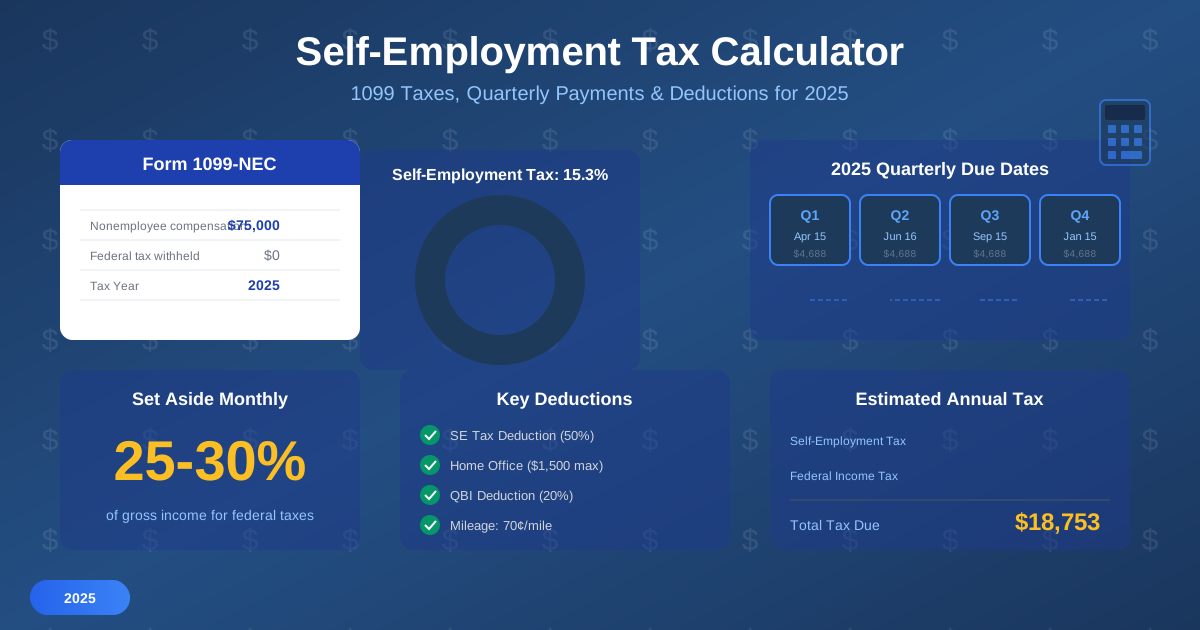
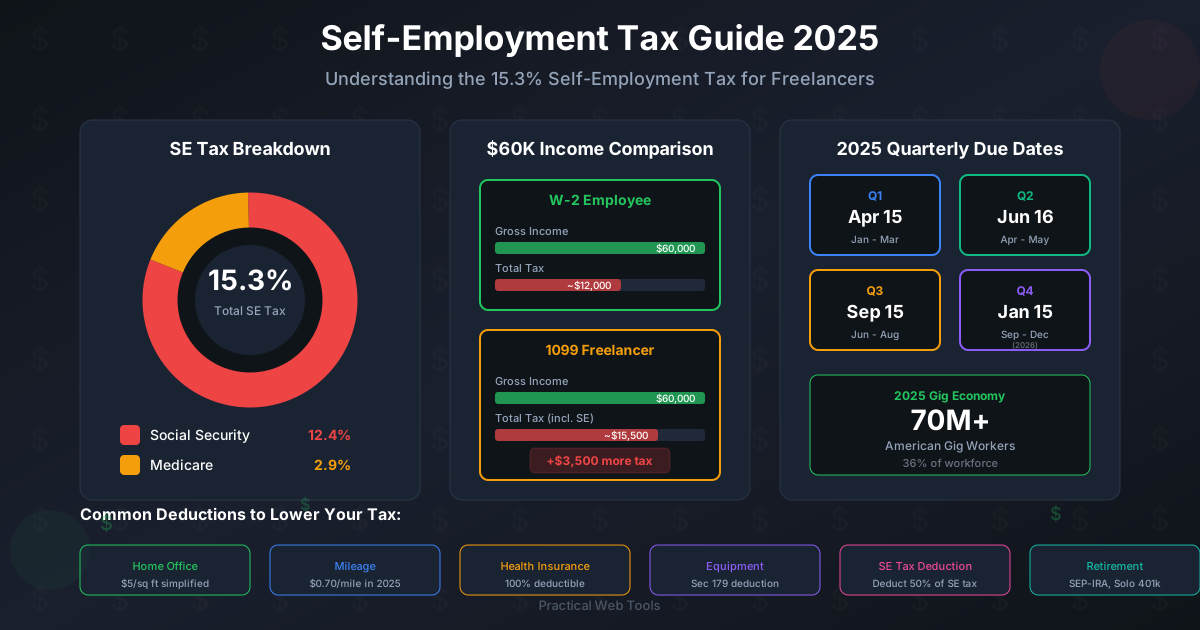
The self-employment tax rate for 2025 is 15.3% (12.4% Social Security + 2.9% Medicare) on net earnings above $400. Freelancers should set aside 25-30% of gross income for federal taxes, including both self-employment tax and income tax.
For example, a freelancer earning $100,000 in net self-employment income owes approximately $14,130 in self-employment tax alone—before income tax. Add federal income tax and the total tax liability reaches $25,000-$35,000 depending on deductions and filing status.
With over 70 million Americans now working independently (36% of the workforce) and projections suggesting 86.5 million will freelance by 2027, understanding self-employment taxes has never been more critical.
This guide explains exactly how self-employment taxes work, what you need to set aside, and how to calculate your quarterly estimated payments for 2025.
→ Calculate your tax liability now with our free Self-Employment Tax Calculator.
What Is the Self-Employment Tax Rate for 2025?
Self-employment tax is 15.3%, consisting of 12.4% Social Security tax and 2.9% Medicare tax. Traditional employees split this with their employers (paying 7.65% each), but freelancers pay the full amount.
2025 Self-Employment Tax Rates
| Tax Component | Rate | Limit |
|---|---|---|
| Social Security Tax | 12.4% | First $176,100 of net earnings |
| Medicare Tax | 2.9% | All net earnings |
| Additional Medicare Tax | 0.9% | Over $200,000 (single) / $250,000 (MFJ) |
| Total SE Tax | 15.3% | Up to $176,100, then 2.9%+ above |
Important calculation note: The IRS applies self-employment tax to 92.35% of your net self-employment income (not 100%), effectively reducing the rate to about 14.13% of gross self-employment income. This mimics how employees are taxed.
How Much Should Freelancers Set Aside for Taxes?
Set aside 25-30% of gross self-employment income for federal taxes. This covers both self-employment tax (~15.3%) and federal income tax (which varies by bracket).
Tax Set-Aside by Income Level
| Self-Employment Income | Recommended Set-Aside | Typical Total Tax Rate |
|---|---|---|
| $50,000 | 25% ($12,500) | 20-22% effective |
| $100,000 | 28% ($28,000) | 25-28% effective |
| $150,000 | 30% ($45,000) | 28-32% effective |
| $200,000+ | 35-40% | 32-37% effective |
State taxes add more: California, New York, and other high-tax states require an additional 8-13% set-aside. No-income-tax states (Texas, Florida, Washington) simplify the calculation but do not eliminate the federal burden.
The safest approach: Calculate your actual estimated tax liability using our Self-Employment Tax Calculator, then set aside that amount plus a 10% buffer.
When Are Quarterly Estimated Taxes Due in 2025?
Self-employed individuals who expect to owe $1,000 or more must make quarterly estimated payments or face underpayment penalties.
2025 Quarterly Tax Due Dates
| Quarter | Income Period | Due Date |
|---|---|---|
| Q1 | January - March | April 15, 2025 |
| Q2 | April - May | June 16, 2025 |
| Q3 | June - August | September 15, 2025 |
| Q4 | September - December | January 15, 2026 |
Two Methods for Calculating Quarterly Payments
- Current year method: Estimate total annual tax liability and divide by four.
- Prior year safe harbor: Pay 100% of your previous year's tax liability divided by four (110% if AGI exceeded $150,000). This method protects you from underpayment penalties even if income increases.
Penalty for missing payments: The IRS charges approximately 8% annual interest on shortfalls, compounded daily from the date payment was due. On $40,000 annual tax owed with no quarterly payments, penalties could exceed $1,600.
What Are the 2025 1099-K Reporting Thresholds?
Major change in 2025: The 1099-K threshold has returned to $20,000 AND 200 transactions after the One Big Beautiful Bill Act (signed July 4, 2025) reversed earlier changes.
1099 Threshold Changes
| Form | Tax Year 2024 | Tax Year 2025+ |
|---|---|---|
| 1099-K | $5,000 (no transaction minimum) | $20,000 AND 200 transactions |
| 1099-NEC | $600 | $600 (increases to $2,000 in 2026) |
| 1099-MISC | $600 | $600 (increases to $2,000 in 2026) |
What this means: Someone selling $3,000 on eBay in 2025 will not receive a 1099-K under the restored thresholds. However, the income remains taxable regardless of whether a 1099 is issued—the reporting requirement change does not affect tax liability.
What Deductions Can Self-Employed Workers Claim?
Deductions reduce your net self-employment income, lowering both income tax and self-employment tax. Missing legitimate deductions means paying taxes on income that should be offset by business expenses.
Key Self-Employment Deductions for 2025
| Deduction | Maximum | Notes |
|---|---|---|
| Self-employment tax deduction | 50% of SE tax | Above-the-line, automatic |
| Home office (simplified) | $1,500 | $5/sq ft up to 300 sq ft |
| QBI deduction | 20% of QBI | Phases out at higher income |
| Vehicle mileage | 70 cents/mile | Up from 67 cents in 2024 |
| Health insurance premiums | 100% of premiums | Cannot exceed net SE income |
| SEP-IRA contributions | $69,000 or 25% of net income | Whichever is less |
| Solo 401(k) | $69,000 total | Employee + employer contributions |
Deduction Details
Self-employment tax deduction: You deduct half of your SE tax from gross income—an above-the-line deduction available even without itemizing. On $100,000 of SE income, this saves approximately $1,700 in income tax (at 24% bracket).
QBI deduction: Most self-employed individuals can deduct up to 20% of qualified business income. On $100,000 of QBI, this saves up to $4,800 in federal taxes. Phases out for service businesses above $182,100 (single) or $364,200 (MFJ).
Retirement contributions: SEP-IRA and Solo 401(k) contributions reduce taxable income dollar-for-dollar. A freelancer in the 24% bracket contributing $30,000 saves approximately $11,790 in federal taxes alone.
Don't overpay. Use our Self-Employment Tax Calculator to estimate your exact tax liability including deductions and quarterly payment amounts.
What Are the Biggest Self-Employment Tax Mistakes?
Five costly mistakes that catch freelancers off guard:
-
Not setting aside enough. The 15.3% self-employment tax surprises many new freelancers. Someone who earned $100,000 as an employee and switched to freelancing at the same gross income suddenly owes an additional ~$14,130 in self-employment tax. Setting aside only income tax amounts leaves a massive shortfall.
-
Missing quarterly deadlines. Underpayment penalties apply from the date payment was due, not from tax filing date. Missing all four quarterly payments on $50,000 of tax owed could cost $1,000-$2,000 in penalties and interest.
-
Not tracking expenses. Roughly 35% of self-employed workers fail to properly separate business and personal expenses. This makes tax preparation difficult and often means missing legitimate deductions. Use a separate business account and credit card from day one.
-
Ignoring the QBI deduction. The 20% Qualified Business Income deduction is one of the most valuable tax benefits for self-employed individuals. On $100,000 of qualifying income, missing this deduction costs ~$4,800 in unnecessary taxes.
-
Not maximizing retirement contributions. SEP-IRA and Solo 401(k) contributions reduce both income tax and self-employment tax base. A freelancer in the 24% bracket contributing $30,000 saves approximately $11,790 in federal taxes alone.
What Is the Difference Between 1099 and W-2 Taxes?
1099 contractors pay approximately $6,500 more in taxes than W-2 employees at the same gross income level because they pay both halves of FICA taxes.
1099 vs. W-2 Tax Comparison at $100,000
| Tax Component | W-2 Employee | 1099 Contractor |
|---|---|---|
| FICA (employee portion) | $7,650 | N/A |
| Self-employment tax | N/A | $14,130 |
| Difference | +$6,480 |
What 1099 contractors should charge: Seek 10-15% higher gross rates than equivalent W-2 positions to cover the self-employment tax difference, lack of benefits, and administrative burden. A $100,000 W-2 role with benefits roughly equals a $115,000-$120,000 1099 contract without benefits.
Frequently Asked Questions
How much should I set aside for 1099 taxes? Set aside 25-30% of gross self-employment income for federal taxes. This covers the 15.3% self-employment tax plus federal income tax. Add another 5-10% if you live in a state with income tax. High earners (over $200,000) should set aside 35-40%.
When are quarterly estimated taxes due in 2025? April 15 (Q1), June 16 (Q2), September 15 (Q3), and January 15, 2026 (Q4). Missing these deadlines triggers underpayment penalties even if you pay the full amount by the April tax filing deadline.
What happens if I don't make quarterly payments? The IRS charges underpayment penalties calculated from each quarterly due date at approximately 8% annual interest. For someone owing $40,000 in annual tax who makes no quarterly payments, penalties could exceed $1,600.
Do I owe self-employment tax on all freelance income? Self-employment tax applies to net earnings exceeding $400 annually. Net earnings = gross income minus business expenses. Below $400 after expenses, no self-employment tax is owed, though income tax may still apply.
Can I deduct my home office if I'm a freelancer? Yes, if the space is used regularly and exclusively for business. The simplified method allows $5 per square foot up to 300 square feet ($1,500 maximum). The regular method calculates actual expenses proportional to business use percentage.
What's the difference between 1099-NEC and 1099-K? 1099-NEC reports non-employee compensation paid directly by clients (minimum $600, increasing to $2,000 in 2026). 1099-K reports payments processed through third-party networks like PayPal or Stripe ($20,000/200 transactions threshold in 2025). The same income should not appear on both forms.
Should I form an LLC or S-Corp for tax savings? An S-Corp election can reduce self-employment tax by allowing you to pay yourself a "reasonable salary" and take remaining profits as distributions (not subject to SE tax). This typically makes sense above $80,000-$100,000 in net self-employment income. Consult a tax professional—the compliance costs may outweigh savings at lower income levels.
What is the self-employment tax rate for 2025? 15.3% total: 12.4% Social Security (on first $176,100 of net earnings) plus 2.9% Medicare (on all net earnings). High earners pay an additional 0.9% Medicare surtax on income above $200,000 (single) or $250,000 (married filing jointly).
Calculate Your Self-Employment Tax Liability
Self-employment taxes represent a significant financial obligation. Understanding your liability helps you price your services appropriately, set aside adequate reserves, and avoid unpleasant surprises at tax time.
The calculations can be complex—between self-employment tax, income tax, quarterly estimates, and deductions, there are many moving pieces. Getting an accurate picture of your tax situation early allows you to plan effectively and minimize your legal tax burden.
Use our free Self-Employment Tax Calculator to estimate your total tax liability, see how much to set aside from each payment, and calculate your quarterly estimated tax amounts. Enter your income and deductions to get personalized results based on current 2025 tax rates.