HIPAA-Compliant AI: Running Medical Document Analysis On-Premise in 2025

How do you run HIPAA-compliant AI for medical document analysis? Deploy on-premise AI using open-source models like Llama 3 or Qwen on your own hardware within your HIPAA-compliant infrastructure. This ensures Protected Health Information (PHI) never leaves your network, eliminates the need for Business Associate Agreements with cloud AI providers, and allows complete audit control over all data access. Hardware costs range from $8,000 for a basic setup to $180,000 for enterprise deployment, with ROI typically achieved within 3-5 months compared to cloud AI service fees.
I still remember the call from our compliance officer at 2 AM on a Tuesday. Someone had discovered that three physicians in our cardiology department were regularly copying patient notes into ChatGPT to help summarize lengthy admission histories. They had been doing it for weeks. Hundreds of patient records, complete with names, medical record numbers, diagnoses, and treatment details, had been transmitted to OpenAI's servers. Every single interaction was a HIPAA violation.
The doctors thought they were being innovative. They'd found a tool that saved them 20 minutes per patient summary. Nobody had told them it was illegal. Our IT department didn't know it was happening. And our compliance team discovered it only because one physician mentioned the "amazing AI trick" at a staff meeting.
The investigation took three months. The remediation cost $180,000 in legal fees, compliance consulting, and breach notification preparation. We were fortunate that OCR determined it was a technical violation without evidence of harm, resulting in corrective action requirements rather than financial penalties. But the real cost was the erosion of trust and the chilling effect on any future AI adoption.
That incident taught me something crucial: healthcare organizations desperately need AI capabilities, but cloud-based AI services are fundamentally incompatible with how HIPAA requires us to protect patient information. This isn't a problem you can solve with contracts or policies. It requires a different architecture entirely.
Why Is Cloud AI Incompatible with HIPAA Compliance?
Let me be direct about something many vendors won't tell you: Business Associate Agreements with cloud AI providers don't eliminate your risk. They acknowledge it, create contractual obligations, and establish breach notification requirements. But the fundamental problem remains.
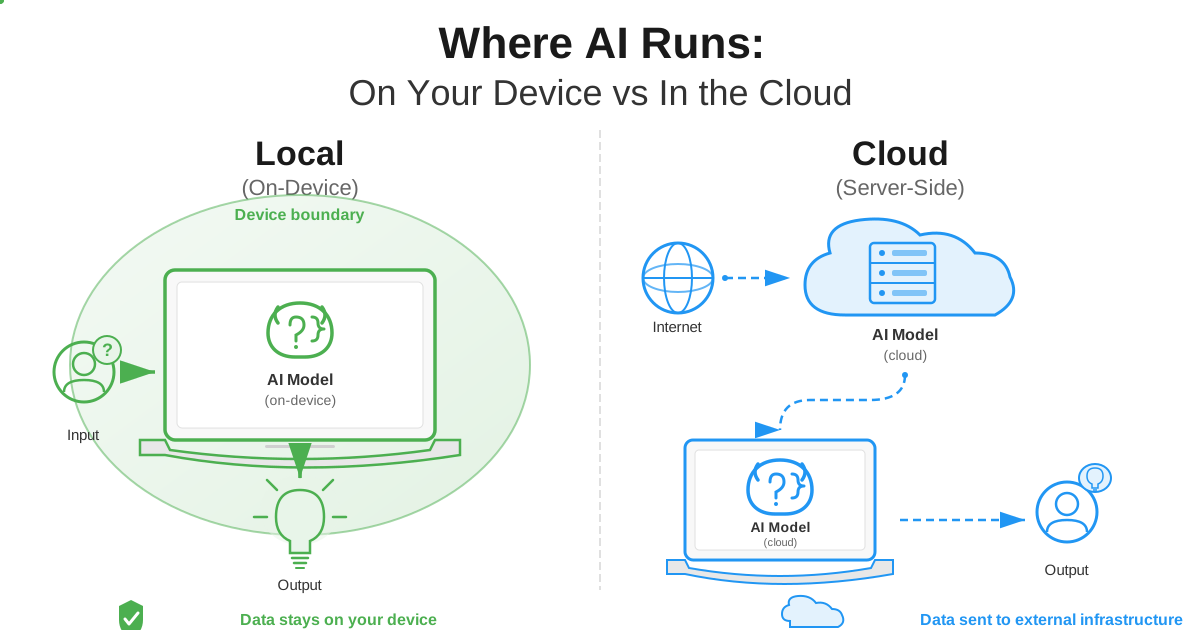
When you send Protected Health Information to a cloud AI service, you lose control. The data leaves your network, travels across infrastructure you don't manage, gets processed on servers you can't audit, and may be stored, cached, or logged in systems you'll never see. Even with the most comprehensive BAA, you're trusting representations you cannot verify.
I've reviewed dozens of enterprise AI contracts. They all contain similar language about "not using customer data for model training" and "implementing appropriate security measures." But none of them explain exactly how queries are processed, where data is temporarily stored during inference, how long logs are retained, or who within the provider's organization can access them.
The technical reality is uncomfortable: cloud AI services are designed for general-purpose use by millions of customers. They prioritize scalability, performance, and continuous improvement. Patient privacy wasn't a design constraint. HIPAA compliance was retrofitted through policies and legal agreements, not architectural decisions.
Consider what happens when a physician asks a cloud AI to summarize a patient's chart:
The query containing PHI is transmitted over the internet to the provider's API gateway. It passes through load balancers, security filters, and content moderators. It gets queued for processing by an available model instance, which might be in any of dozens of data centers across multiple countries. The model generates a response, which travels back through multiple systems before reaching the physician's screen.
At every step, systems are logging, monitoring, and analyzing traffic for security, performance, and billing purposes. The AI provider's employees can potentially access these logs for troubleshooting, security investigations, or model improvement. The data crosses networks and jurisdictions with different legal frameworks and surveillance capabilities.
And here's what keeps compliance officers awake: you can't audit any of it. You depend entirely on the provider's representations about their security practices, data handling, and access controls.
Which HIPAA Security Rule Requirements Does Cloud AI Violate?
Let me walk through the specific regulatory requirements that cloud AI makes nearly impossible to satisfy.
Under the Security Rule's access control requirements at 45 CFR 164.312(a)(1), covered entities must implement technical policies ensuring that only authorized persons or programs can access electronic PHI. When patient data enters a cloud AI system, the covered entity cannot verify who has access to it within the provider's infrastructure. Engineers maintaining the AI system, security teams monitoring for threats, and customer support staff troubleshooting issues may all have technical access.
The audit control requirements at 164.312(b) mandate recording and examining activity in systems containing ePHI. Cloud AI providers maintain their own logs, but covered entities can't independently audit them. You can't verify that the logs are complete, accurate, or that they capture all access to your patients' data. You're accepting the provider's assertions.
The integrity control requirements at 164.312(c)(1) require protecting ePHI from improper alteration or destruction. Once patient information enters a cloud AI system, you lose the ability to verify what happens to it. Is it cached? Is it used to improve content filters? Does it influence model behavior even if not formally used for training? You can't know.
The transmission security requirements at 164.312(e)(1) require guarding against unauthorized access to ePHI being transmitted over electronic networks. While TLS encryption protects data in transit, the data must be decrypted at the provider's servers for processing. You can't verify the security measures at that destination.
How Do You Implement On-Premise AI in a Healthcare Setting?
After our compliance incident, I spent six months researching alternatives. We needed AI capabilities that could operate entirely within our HIPAA-compliant infrastructure without sending patient data anywhere.
The solution turned out to be simpler than expected: we run our own large language models on servers in our data center. No internet connection required. No external APIs. No third-party processors. Complete control over every aspect of how patient information is handled.
We started with a proof of concept in our quality improvement department. They needed to extract specific data elements from clinical notes for quality measures. Previously, this required hours of manual chart review. We deployed a Llama 3 70B model on a server with two NVIDIA A100 GPUs.
The results were remarkable. The AI could analyze a complete patient chart and extract required quality measure data elements in under 30 seconds. Accuracy was comparable to manual review. And critically, every query, every response, and every piece of patient information remained entirely within our network.
What made it HIPAA-compliant wasn't just keeping data on-premise. It was that we could implement and verify every single Security Rule requirement using standard healthcare IT practices:
We integrated the AI system with our existing Active Directory for access control. Only authorized clinical staff with specific role-based permissions can access it. We require multi-factor authentication. We log every query with user identification, timestamps, and session information. Those logs are stored on our HIPAA-compliant logging infrastructure with the same retention policies as our EHR logs.
The AI servers sit in our data center with the same physical security controls as our other clinical systems: biometric access, 24/7 monitoring, and environmental controls. We audit them using the same processes as our other systems. We can produce complete documentation of security controls for compliance reviews.
When our auditors asked how we ensure AI-processed PHI is protected, I could show them exactly how. Because it's our infrastructure, running our software, following our policies.
What Are Practical Use Cases for On-Premise Medical AI?
Let me share the specific applications we've deployed and the results they've delivered.
Clinical Documentation Assistance
Our emergency department physicians were drowning in documentation requirements. A typical ED visit generates pages of notes. We built an AI assistant that helps summarize patient presentations, suggest assessment and plan structures, and draft discharge instructions based on the encounter.
The physician reviews and edits everything before signing, so the AI isn't making clinical decisions. But it's saving each ED physician 45 minutes per shift on documentation time. That's time they can spend with patients instead of with keyboards.
Implementation: We use a Llama 3 70B model fine-tuned on medical literature. The model runs on dedicated servers with 160GB of RAM and dual A100 GPUs. Response time averages 3-5 seconds for a complete encounter summary. Total infrastructure cost: $65,000 one-time, zero per-use costs.
Quality Measure Extraction
Quality reporting requires extracting specific data elements from clinical documentation. Manual review is time-consuming and inconsistent. We deployed AI to identify patients meeting quality measure criteria and extract supporting documentation.
The AI reviews clinical notes and structures data for quality measures. A human reviewer validates the extractions before submission. We've reduced quality measure data collection time by 70% while improving consistency.
Implementation: We use Qwen 2.5 72B for its strong instruction-following capabilities. The system processes batch jobs overnight, analyzing thousands of records. Results are ready for human review each morning.
Prior Authorization Documentation
Insurance prior authorizations require clinical narratives justifying medical necessity. Physicians were spending hours weekly writing these justifications from clinical notes.
Our AI extracts relevant clinical information and generates draft prior authorization narratives. The physician reviews, edits, and signs. Authorization approval rates are unchanged, but physician time per authorization dropped from 25 minutes to 8 minutes.
Implementation: We fine-tuned a specialized model on our historical authorization documents and payer requirements. The system integrates with our EHR workflow, pulling relevant clinical data automatically.
Denial Management Analysis
Understanding why insurance claims get denied requires analyzing denial letters, claims data, and clinical documentation together. Our revenue cycle team was manually reviewing denied claims to identify patterns.
We deployed AI to analyze denied claims, extract denial reasons, compare against clinical documentation, and suggest appeal strategies. Our appeal success rate increased from 32% to 47% because we're identifying the actual documentation gaps.
Implementation: This was our first application and runs on more modest hardware - a workstation with an RTX 4090 GPU running Mistral 7B. Performance is adequate for the batch processing workflow.
What Technical Architecture Enables HIPAA-Compliant AI?
Let me give you the specific technical details of how we've architected this for HIPAA compliance.
Hardware Infrastructure
We run two GPU servers for high-demand applications and three workstations for batch processing:
- Primary AI Server: Dell PowerEdge R760xa with dual NVIDIA A100 80GB GPUs, dual Xeon Gold 6448Y processors, 512GB RAM, 8TB NVMe SSD storage
- Secondary AI Server: Similar configuration for redundancy and load balancing
- Batch Processing Workstations: High-end desktops with RTX 4090 24GB GPUs, 128GB RAM
Total hardware investment: $180,000. For context, we were spending $35,000 monthly on an enterprise AI transcription service. The hardware paid for itself in five months.
Network Architecture
The AI servers sit on a dedicated VLAN within our clinical network. Firewall rules prevent any outbound internet connectivity from these servers. They can only communicate with our EHR systems, identity management infrastructure, and logging systems.
We use TLS 1.3 for all internal API communications. Network traffic is monitored for anomalies. Any attempted outbound connection generates an immediate security alert.
Software Stack
We run Ubuntu Server 22.04 LTS as our base operating system. For AI inference, we use vLLM for production workloads and Ollama for development and testing. Both support OpenAI-compatible API endpoints, making integration straightforward.
We built a custom API gateway that handles authentication, authorization, rate limiting, logging, and request routing. It integrates with our Active Directory for single sign-on. Every API request is logged with user identity, timestamp, full request content, and full response content.
For model storage and versioning, we use our existing enterprise storage systems with the same backup and disaster recovery procedures as our EHR data.
Model Selection Strategy
We maintain multiple models for different use cases:
- Llama 3.3 70B: Primary model for clinical documentation, complex reasoning tasks
- Qwen 2.5 72B: Excellent for structured data extraction and following complex instructions
- Mistral 7B: Fast responses for simpler tasks, lower resource requirements
- Domain-specific fine-tuned models: For specialized tasks like prior authorization or specific quality measures
We evaluate new models in our development environment before promoting to production. The evaluation includes clinical accuracy testing, performance benchmarking, and security validation.
What Documentation Do HIPAA Auditors Require for AI Systems?
When OCR or other auditors review your AI systems, they want specific documentation. Here's what we prepared:
System Security Plan: Comprehensive documentation of security controls, including access control mechanisms, audit procedures, encryption methods, network architecture, physical security, and incident response procedures specific to the AI systems.
Risk Analysis: Formal risk assessment identifying threats to ePHI in the AI systems, likelihood and impact of potential security incidents, and implemented safeguards mitigating identified risks. We update this annually.
Policies and Procedures: Written policies governing AI system use, acceptable use requirements, authorization procedures, training requirements, sanctions for misuse, and data handling procedures.
Audit Logs: We maintain comprehensive logs of all AI system activity: user identification, query timestamps, complete query content, complete response content, session information, and access attempts (successful and failed). Logs are retained for seven years in compliance with our record retention policy.
Training Documentation: All staff using AI systems complete specific training on appropriate use, HIPAA requirements, and the importance of reviewing AI outputs rather than blindly trusting them. We maintain training records.
Business Continuity Plan: Documentation of backup procedures, disaster recovery plans, redundancy architecture, and failover testing results for AI systems.
When auditors asked to review our AI compliance controls, we provided this documentation package. Their response: "This is how clinical systems should be documented." The on-premise architecture made compliance straightforward to demonstrate.
What Does On-Premise AI Cost Compared to Cloud Services?
Let me give you real numbers from our experience.
Cloud AI Costs (what we would have paid)
Based on our usage patterns and pricing for enterprise healthcare AI services:
- Clinical documentation: $45,000/month (per-note pricing)
- Quality measure extraction: $12,000/month (per-record pricing)
- Prior authorization: $8,000/month (per-authorization pricing)
- Total: $65,000/month or $780,000/year
Plus legal and compliance costs for BAA negotiation, ongoing vendor risk assessment, and continuous monitoring of vendor compliance.
On-Premise Costs (actual)
- Hardware: $180,000 one-time
- Software licensing: $0 (open-source models and inference software)
- Electricity (estimated): $400/month
- IT staff time: Absorbed into existing infrastructure team, approximately 10 hours/month ongoing maintenance
- Total first year: $184,800
- Subsequent years: $4,800 annually
The ROI is dramatic. We recouped the entire infrastructure investment in three months. Every month after that represents pure savings.
But the financial case understates the compliance benefits. We eliminated vendor risk, simplified our compliance posture, and gained complete control over patient data. Those benefits don't have a simple dollar value, but they matter enormously.
What Hardware and Skills Do You Need for On-Premise Medical AI?
If you're considering on-premise AI for your healthcare organization, here's what you actually need:
Minimum Viable Infrastructure
You can start smaller than you think. A single high-end workstation can run useful models:
- Workstation: $8,000-$12,000
- CPU: AMD Ryzen 9 7950X or Intel Core i9-14900K
- RAM: 128GB DDR5
- GPU: NVIDIA RTX 4090 24GB
- Storage: 2TB NVMe SSD
This configuration runs Mistral 7B or Llama 3.2 8B models smoothly. It's sufficient for pilot projects, batch processing workloads, or small departments.
Technical Skills Required
You don't need a specialized AI team. If your IT staff can manage Linux servers and Docker containers, they can manage this. The learning curve is similar to deploying any new enterprise application.
We had zero AI expertise when we started. Our infrastructure team learned what they needed through documentation and experimentation. Within a month, they were comfortable managing the AI systems.
Implementation Timeline
Here's how long each phase actually took us:
- Week 1-2: Hardware procurement and setup
- Week 3: Software installation and configuration
- Week 4: Security hardening and compliance review
- Week 5-8: Model evaluation and selection for specific use cases
- Week 9-12: Integration with existing EHR and workflow systems
- Week 13+: User training and staged rollout
Total time from decision to production: three months. That included extensive testing and compliance review. You could move faster if necessary.
What Are the Limitations of On-Premise Medical AI?
On-premise AI isn't perfect. Let me be honest about the limitations:
Model Capability Gaps: The largest on-premise models we can practically run (70-72B parameters) are less capable than GPT-4 or Claude 3.5 Sonnet on complex reasoning tasks. For most healthcare documentation tasks, the difference doesn't matter. But for truly cutting-edge applications, cloud models have advantages.
Hardware Management Burden: You're responsible for hardware maintenance, security patching, model updates, and troubleshooting. This is familiar territory for healthcare IT, but it's real work.
Initial Expertise Gap: There's a learning curve. Your team needs to understand model selection, inference optimization, and prompt engineering. This knowledge is acquirable, but it takes time.
Scaling Challenges: Adding capacity means buying hardware, not adjusting a slider in a cloud console. You need to forecast demand and provision accordingly.
For us, these tradeoffs are obvious winners. The compliance benefits and cost savings far outweigh the operational complexity. But your calculation might differ depending on your organization's size, technical capabilities, and risk tolerance.
Frequently Asked Questions About HIPAA-Compliant AI
Is using ChatGPT with patient data a HIPAA violation?
Yes, in most cases. Entering Protected Health Information into consumer AI services like ChatGPT, Claude, or Gemini constitutes unauthorized disclosure to a third party without a Business Associate Agreement. Even with a BAA, the fundamental architecture of cloud AI creates compliance challenges because you cannot verify access controls, audit data handling, or ensure complete deletion.
Can a Business Associate Agreement make cloud AI HIPAA-compliant?
A BAA is necessary but not sufficient. It creates contractual obligations and breach notification requirements, but the fundamental problem remains: PHI leaves your control, exists on servers you cannot audit, and may be accessed by employees you cannot verify. On-premise AI eliminates these concerns entirely.
What penalties can healthcare organizations face for AI-related HIPAA violations?
Penalties range from $100 to $50,000 per violation, with annual maximums up to $1.5 million per violation category. Willful neglect with no correction can result in criminal penalties including imprisonment. Beyond financial penalties, enforcement actions include corrective action plans, external monitoring, and significant reputational damage.
How long does it take to implement on-premise AI in a healthcare setting?
Typical implementation takes three months from decision to production: 2 weeks for hardware setup, 2 weeks for software configuration and security hardening, 4 weeks for model evaluation and EHR integration, and 4+ weeks for user training and rollout. Faster implementation is possible with less extensive testing.
Can on-premise AI match cloud AI quality for medical documentation?
For clinical documentation summarization, quality measure extraction, and prior authorization drafting, on-premise models like Llama 3.3 70B match cloud services for most tasks. Complex diagnostic reasoning and novel medical analysis may show quality gaps. For 80% of typical healthcare AI use cases, on-premise quality is fully adequate.
What is the minimum hardware investment for on-premise medical AI?
A single workstation with RTX 4090 GPU, 128GB RAM, and 2TB SSD costs approximately $8,000-12,000 and can run useful models for pilot projects or small departments. Enterprise deployments with redundancy and capacity for multiple concurrent users require $100,000-200,000 in hardware investment.
Does on-premise AI require specialized AI expertise?
No. If your IT staff can manage Linux servers and Docker containers, they can manage on-premise AI. The learning curve is similar to deploying any new enterprise application. Most healthcare organizations with competent IT departments can become comfortable managing AI systems within a month.
What Is the Future of HIPAA-Compliant AI?
The trajectory is clear: on-premise AI is becoming more capable, more efficient, and easier to deploy every quarter.
New models provide better capabilities in smaller packages. Llama 3.3 70B matches the previous generation's 400B models in many tasks. Improved quantization techniques maintain quality while reducing memory requirements by 75%. Hardware accelerators in every new processor generation make inference faster and more efficient.
Healthcare-specific open models are emerging. Medical fine-tuned versions of Llama and Mistral understand clinical terminology and reasoning. Specialized models for radiology, pathology, and medical coding are being developed by the open-source community.
The compliance landscape is tightening. OCR is becoming more aggressive about cloud AI violations. State attorneys general are investigating healthcare data privacy. The organizations that get ahead of this shift will avoid painful enforcement actions.
Three years from now, I predict most healthcare organizations will run critical AI workloads on-premise. The technology is ready today. The business case is compelling. The compliance advantages are decisive.
The only question is whether you'll be early or late to this transition.
Take Action: Your Next Steps
If this resonates with your organization's needs, here's what to do next:
This Month: Assess current AI usage in your organization. Are clinicians or staff using consumer AI tools with patient data? Document the compliance risk. Survey departments about AI use cases they'd value.
Next Quarter: Build a business case for on-premise AI. Include hardware costs, potential use cases, estimated ROI, and compliance benefits. Identify a pilot use case with clear success metrics. Engage your compliance and IT leadership.
This Year: Implement a pilot. Start with a single use case in one department. Prove the technology works, delivers value, and maintains compliance. Use success to justify broader rollout.
The healthcare organizations that master compliant AI deployment will deliver better patient care, support clinicians more effectively, and operate more efficiently than competitors stuck choosing between compliance and innovation.
You don't have to choose. The technology exists today to have both.
Want to see how local processing protects sensitive information? Our browser-based document tools process everything on your device using the same privacy-first architecture that makes on-premise AI compliant. Whether you're converting PDFs, merging documents, or extracting text, your files never leave your computer. It's the same principle that makes on-premise healthcare AI work: process data where it lives, never transmit sensitive information externally.